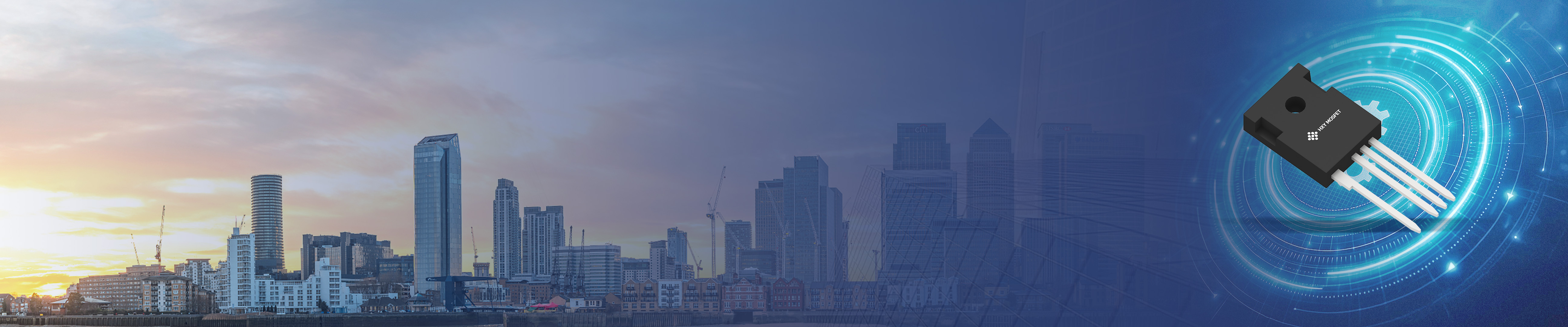
HXY Electronics‘ 650V SiC MOSFET HXYS52N65MPI (650V/52A/40mΩ/TO-247H-4L Kelvin-source package) targets 400V-bus AC-DC power supplies in PFC and LLC stages: nanocoulomb-class body-diode Qrr, roughly 1.5x RDS(on) at 175°C, and 0V turn-off single-polarity gate drive — performance and pricing advantages during the current silicon MOSFET shortage cycle.
This article is written for engineers doing AC-DC power-supply selection: R&D and component-selection engineers working on server PSUs, telecom rectifiers, LED drivers, and fast-charger/adapter designs, plus the hardware project managers squeezed between lead times and BOM cost. You share a common situation — on the 400V PFC bus, the power switch has long defaulted to a silicon superjunction MOSFET, and "SiC is too expensive" has been the standing meeting conclusion.
In 2026, that conclusion is being challenged. On one side, silicon MOSFETs have gone through consecutive rounds of price increases with extending lead times. On the other, SiC single-switch pricing has trended down for three consecutive years, and some 650V consumer-class parts now carry market prices below RMB 1. When the two price curves cross, the old perception of "better performance but higher cost" needs a fresh audit. This article separates the market economics from the technical comparison. The conclusion first: in typical 400V-bus power-supply operating points, SiC‘s performance advantage is structural; its price advantage is becoming real in specific market segments, and the system-level total cost has already flipped in a broader set of designs.
The first pain point is supply. Since the start of 2026, the power semiconductor industry has entered a defined price-increase cycle: overseas vendors moved first, domestic vendors followed, and publicly disclosed silicon MOSFET hikes range from 10% to 20%, with AI-datacenter-related power products rising higher. Lead times for high-voltage silicon MOSFETs have stretched widely, with some specifications quoted beyond 20 weeks. For a power-supply manufacturer consuming millions of parts per year, a 15% increase on one part is a margin problem for an entire product line; and qualifying an alternative means re-certification and re-validation, so engineers‘ time gets hostage to the supplier‘s quotation sheet.
The second pain point is the performance ceiling. Efficiency certifications keep escalating — titanium-class efficiency, high power density, fan-less or sealed enclosures — and each of these pushes switching frequency upward. Data-center power efficiency benchmarks have reached 97.5% and beyond, consumer chargers face energy-efficiency regulations tightening year by year, and the room for "brute-forcing losses with a bigger heatsink" keeps shrinking. But the silicon superjunction‘s body-diode reverse-recovery charge (Qrr) is a hard loss in high-frequency hard switching: push past roughly 100kHz and the loss budget no longer balances. Meanwhile, superjunction on-resistance rises significantly at temperature — by industry-public figures roughly 2.5x from 25°C to 175°C — so a hot ambient forces a larger heatsink, giving back the power-density gains. Frequency capped from above, temperature capped from below — with both paths blocked, the silicon device generation is close to converging on its performance limit.
The third pain point is a stale decision basis. The "SiC is expensive" impression mostly dates from 2023-2024 quotations, while SiC substrate and device pricing has been falling continuously since. Making new designs with old price tags distorts the selection conclusion by construction.
Price inversion is not a slogan; it is the outcome of supply structure. Take the two supply sides apart and the logic becomes clear.
On the silicon side: capacity contraction plus demand diversion. Global 200mm (8-inch) mature-node wafer capacity turned to negative growth in 2026; leading foundries have been cutting 8-inch capacity year by year with some sites slated for closure, and industry estimates put the combined mature-node reduction at roughly ten percent. Power MOSFETs are precisely heavy consumers of 8-inch capacity — AI server power per rack keeps climbing, high-voltage MOSFETs are locked up by compute-power orders, and general-purpose parts clear out of the spot market quickly. With supply contracting, demand diverting, and raw-material plus packaging-test costs rising together, silicon MOSFET pricing has nowhere to go but up, and industry observers expect the tightness to persist near-term.
On the SiC side: cost reduction is the industry‘s main trendline. 150mm SiC substrate prices have fallen sharply from their 2023 highs — industry-public data puts them at less than half of the earlier peak. 200mm SiC fabs entered volume ramp in 2026; die count per wafer has grown from just over a hundred to more than three hundred, cutting unit die cost by roughly thirty percent. Add domestic substrate and epitaxy capacity coming online, plus laser-cutting and yield improvements, and SiC device average selling prices have been declining at roughly 10%-15% per year, with 1200V single switches falling from the hundred-yuan class to the tens-of-yuan class over three years.
One curve rising, one falling — the crossover lands on the 650V battlefield. Industry observers report that consumer-class 650V SiC MOSFETs now price below RMB 1, approaching or undercutting same-spec silicon superjunction MOSFETs. A precise boundary must be drawn here: price inversion is currently a segment phenomenon — it shows up mainly in consumer-class part numbers, spot-market channels, and specific parameter grades; in contract pricing and automotive-qualified segments, a spread between silicon and SiC remains. So the engineering conclusion is not "SiC is cheaper everywhere" but "audit with today‘s quotation — silicon is no longer cheap by default." Prices move every quarter, and the selection basis must track the market.
The audit itself needs method, or the comparison gets polluted by quoting conventions. First, parameter normalization: when silicon and SiC sit at different RDS(on) grades, compare price per unit of on-resistance rather than pitting a 75mΩ silicon part directly against a 40mΩ SiC part on unit price. Second, channel normalization: spot, contract, and long-term agreement prices move differently — during a shortage cycle, spot elasticity far exceeds contract pricing, so the channel basis must be stated with every quotation. Third, time stamps: record silicon price steps by effective dates on the vendors‘ price-increase letters and SiC reductions by quarter, so every data point on both curves enters the design documentation with a date attached. Only after these three steps does "price inversion" graduate from industry rumor to a traceable line in a selection report.
Beyond the market math, the technical comparison is hard evidence. The two devices below come from the same product family at HXY, same voltage class and same package family: silicon HXYJ43N65MP (650V/43A/75mΩ/TO-247) versus SiC HXYS52N65MPI (650V/52A/40mΩ/TO-247H-4L Kelvin-source four-pin).
| Parameter | HXYJ43N65MP (Silicon) | HXYS52N65MPI (SiC) | Engineering Meaning |
|---|---|---|---|
| VDS rating | 650V | 650V | Same mainstream class for 400V PFC buses, ~1.2-1.4x margin |
| Current ID | 43A | 52A | Higher current capability in the same package footprint |
| RDS(on) | 75mΩ | 40mΩ | Conduction loss nearly halved at equal current and temperature |
| Package | TO-247 (3-pin) | TO-247H-4L (Kelvin source) | Drive loop separated from power loop — cleaner high-frequency switching |
| Body-diode Qrr | Microcoulomb class (per datasheet) | Nanocoulomb class | A generational gap — the key to high-frequency hard switching and totem-pole topologies |
| High-temp RDS(on) | ~2.5x at 175°C (industry-public) | ~1.5x at 175°C (industry-public) | Loss budget stays stable at full-load ambient; heatsink can shrink |
| Suitable frequency | ~65-100kHz | ~150-250kHz | Doubling frequency shrinks PFC and LLC magnetics volume |
| Gate drive | Conventional silicon drive | +15~18V/0V single-polarity (0V turn-off supported) | No negative rail needed; simplified drive architecture retained |
Placed into the typical application circuit: take a 1-2kW telecom rectifier or server PSU — a CCM Boost PFC or totem-pole PFC front end, followed by an LLC half bridge. The control stage issues PWM from a PFC/LLC controller or DSP with switching frequency set in the hundred-kHz range. The drive stage gives each switch one isolated gate-driver channel; the SiC side drives at +15~18V on and 0V off — because the design supports 0V turn-off, the driver needs only a single positive supply, no negative rail, with propagation delays in the 100ns class to match dead-time accuracy. In the power stage, the Kelvin source of HXYS52N65MPI strips drive-loop stray inductance out of the power loop, keeping the gate waveform clean under high-dv/dt edges and further reducing switching loss versus the 3-pin package (industry-public comparisons, up to roughly a third lower). The load stage connects through the transformer and rectifier to the bus capacitor: raising frequency from 100kHz to 200kHz shrinks magnetics and filter volume in step, stepping the whole unit up a power-density class.
Every link in this signal chain is something the silicon solution cannot achieve at equal frequency: the generational Qrr gap decides whether the high-frequency leg works at all, temperature-stable on-resistance decides the thermal budget, and the Kelvin package decides gate-drive robustness under high dv/dt. Once the technical math is done, SiC‘s advantage is structural — it does not depend on market fluctuation.
Translating the performance gaps into numbers engineers can see: take the PFC stage of a 2kW telecom rectifier, estimate conduction loss at 12A RMS under high-temperature operation. The silicon 75mΩ device, applying the industry-public multiplier of roughly 2.5x at 175°C junction temperature, presents an effective on-resistance near 187mΩ — about 27W of conduction loss. HXYS52N65MPI‘s 40mΩ, with the SiC multiplier of roughly 1.5x, presents roughly 60mΩ effective — about 8.6W. The difference at identical operating conditions is roughly 18W, and every watt of it lands on the heatsink, the fan, and the efficiency number. The frequency side converts just as directly: PFC boost inductance scales approximately inverse with switching frequency, so moving from 100kHz to 200kHz roughly halves magnetics volume and weight — that is board space reclaimed and cooling cost removed inside the enclosure. The premium paid at the device level gets recovered line by line in the system ledger — which is exactly why "system-level total cost" sits closer to the real procurement decision than "device unit price."
First, compare prices with "today‘s quotation" and "the system-level ledger." Device unit price is one cell of the BOM; fold in the magnetics shrink from higher frequency, the reduced cooling cost, and the certification headroom from efficiency gains, and system-level cost has already flipped in many designs. Conversely, in cost-sensitive designs below roughly 65-100kHz, silicon superjunction remains the economical choice — the crossover moves with topology and operating point, so audit project by project.
Second, SiC is not a pin-to-pin drop-in. The gate-drive window, gate-resistor starting values, and Miller-platform handling all differ from silicon practice; carrying over silicon drive settings and powering up directly raises bridge-shoot-through risk substantially. Start gate resistance low and converge with measured waveforms.
Third, route the Kelvin source independently. The fourth pin of TO-247H-4L is the drive-dedicated source return — route it separately from the power loop and return it close to the driver ground, or the four-pin package benefit gets eaten by layout.
Fourth, add Miller clamping in high-dv/dt corners. In totem-pole PFC high-frequency half-bridges and similar operating points, the turn-off Miller injection needs clamping or a backstop measure. The 0V turn-off design lowers the bar but does not remove the verification obligation — let the measured gate waveform decide.
Fifth, write supply and price anchors into the design documentation. Record the quotation date and channel basis in the selection conclusion, and keep one validated alternative path for both silicon and SiC — so if the market moves again, the switching cost has already been paid.
The market structure is changing: the 8-inch capacity contraction behind silicon MOSFETs is not a short-term disturbance but a long-term migration of capacity toward higher-value product lines; SiC‘s cost reduction is not a promotion but the result of 200mm ramp and a maturing domestic supply chain. For engineers on 400V-bus power supplies, the technical math shows SiC‘s advantage is structural, and the market math shows the crossover has arrived — when the two curves meet, re-running the audit is one of the cheapest steps in the selection process.
HXY Electronics is a power semiconductor device manufacturer with product lines covering silicon MOSFETs, SiC MOSFETs, and SiC diodes. Both devices compared here — HXYS52N65MPI (650V/52A/40mΩ/TO-247H-4L) and HXYJ43N65MP (650V/43A/75mΩ/TO-247) — are production part numbers. Refer to official datasheets for detailed parameters; for selection and technical support, contact sales@hxymos.com.
Market and industry data cited in this article come from public channels (TrendForce, Cailian Press, and industry media reports); prices reflect publicly reported market figures and are for selection reference only, not procurement advice. Comparison conclusions are based on industry-public data and product nominal parameters; actual performance should be verified by application-specific testing.
声明 / Disclaimer
本文部分参数引自华轩阳产品手册或第三方规格书,数据有更新可能,仅供选型参考,最终设计请以最新版规格书与实测为准。
联系 Contact:sales@hxymos.com



 Contact
 E-mail
 ChatNow